Layered Histories and Untapped Value: An Investment Case for Hera

Hera Büyüktaşcıyan occupies a paradox in today’s contemporary art landscape: institutionally established, critically regarded, yet still conservatively priced relative to her visibility. Born in Istanbul in 1984, she has developed a multidisciplinary practice that examines memory, architecture, ecology, and erasure—showing how personal and collective narratives are shaped by displacement, rupture, and the slow violence of urban change. Her profile is not emerging in the usual sense; rather, it is a case where recognition has arrived through museums and biennials faster than market valuation.
Memory as Method: Positioning the Practice
At the core of Büyüktaşcıyan’s practice is an understanding of art history as layered terrain rather than linear record. Drawing from archaeology, Byzantine iconography, shifting neighbourhood geographies, and natural cycles, she treats the past as sediment: compressed, fractured, and frequently rendered invisible by dominant narratives. Her recurring attention to waterways, façades, textiles, and organic surfaces is less nostalgic than diagnostic—an inquiry into what a city remembers, what it suppresses, and what returns as trace.
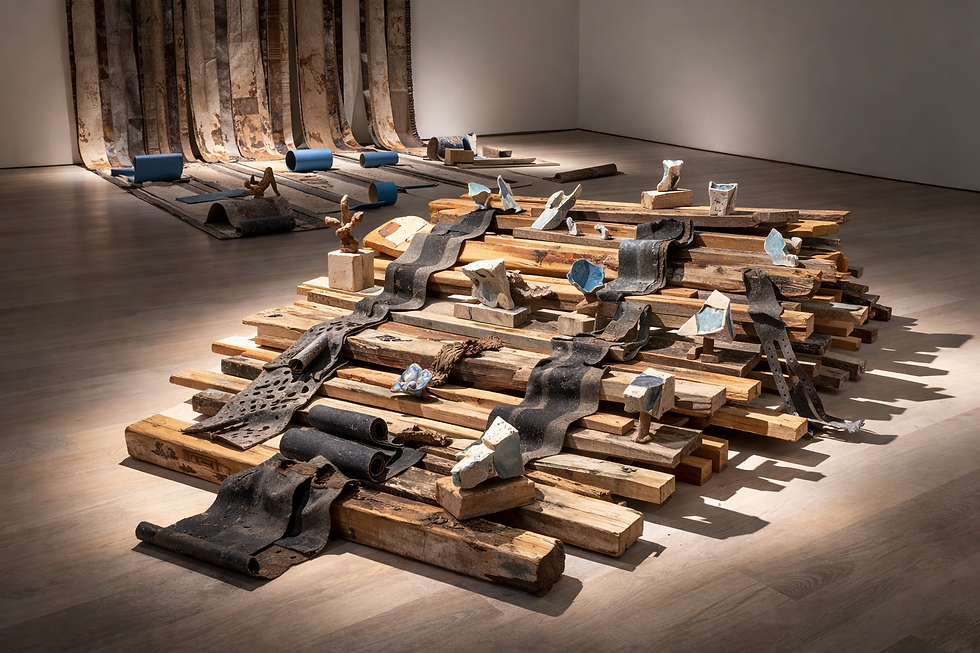
Material, Absence, and Aesthetic Intelligence
Büyüktaşcıyan’s aesthetic is defined by restraint, precision, and tonal complexity. Works such as The Coat of an Early River (2025) extend graphite frottage onto fabric to map erased waterways of Istanbul, translating disappearance into tactile evidence. In Seldom Seen Soon Forgotten (2018), translucent capiz shells—historically used as windowpanes in Southeast Asia—allow light through while blurring the outside world, producing a poised metaphor for selective visibility and historical amnesia. Dendrologia (2023), composed of suspended tree bark alongside sound, turns nature into a wounded archive—an ecosystem that carries memory even when human documentation fails.
Across these works, materials are never merely formal choices: fabric, shell, wood, and stone operate as carriers of testimony. Büyüktaşcıyan avoids spectacle in favour of accumulation—an approach that positions her within a slower register of contemporary art, rewarding sustained attention rather than instantaneous legibility. The result is a practice that feels both intimate and architectural: personal memory scaled up into public structure.

Institutional Gravity and Curatorial Endorsement
This conceptual discipline is matched by substantial institutional validation. Büyüktaşcıyan has held solo exhibition at Tate St Ives, and her work has entered collections including Tate Modern, the British Museum, Centre Pompidou and Arter. These placements matter because they function as long-term credibility engines: acquisitions and museum programming are among the most durable mechanisms by which art history is written and revised. Curators consistently situate her work within urgent debates—memory politics, ecological precarity, displacement, and the ethics of witnessing. In other words, her institutional narrative is already coherent and cumulative, even if the commercial narrative remains comparatively quiet.
Biennials as Signal, Not Spectacle
Her biennial résumé reinforces this structural strength. Büyüktaşcıyan appeared in the Armenian Pavilion at the 56th Venice Biennale (Golden Lion-winning pavilion), and has since participated in the Istanbul Biennial, Biennale of Sydney, and the 2025 Taipei Biennial. These platforms prioritise research and discourse over sales velocity, so repeated inclusion signals curatorial conviction rather than trend-following visibility.

Market Visibility Versus Price Discovery
From an art market perspective, her profile shows a clear imbalance: limited auction exposure, minimal secondary turnover, and low speculative churn. Where prices exist, they remain comparatively accessible against peers with similar institutional trajectories. This does not imply weak demand; it suggests controlled supply and a career built primarily through museums and disciplined gallery stewardship—especially via Green Art Gallery (Dubai) and Galerist (Istanbul). For collectors, that combination often precedes re-rating: strong foundations, muted hype.
The Art Investment Logic: Where Institutions Lead Markets
For collectors and investors, the gap between institutional validation and market pricing supports a straightforward investment thesis. First, institutional momentum is compounding while price discovery lags. Second, Büyüktaşcıyan’s themes align with long-duration curatorial priorities, supporting resilience across market cycles. Third, constrained secondary availability can limit downside while preserving upside as visibility consolidates. In a market often driven by velocity, Büyüktaşcıyan offers a different proposition: substance ahead of speculation. Her work is already positioned within global contemporary art discourse; the market simply has not priced that position fully. For those seeking conviction, this may be precisely where thoughtful investment begins.
----------
*The views expressed in this article are solely personal opinions and should not be considered as investment advice.
*Disclaimer: Unless otherwise stated, all images featured in this article are AI-generated for illustrative purposes. They are not based on, affiliated with, or reproductions of any existing copyrighted images or artworks.
Cenk Usel
Art Market Professional


Comments